
Uniform Commercial Code
Article 9 · Section 609

The Statute.
The Gap.
The System.

UCC §9-609 permits self-help repossession — but only without breach of the peace. The statute provides no operational guidance for what that means in the field. The Peace Point™ System does.

Published Framework UCC §9-609 Compliance Peace Point™ System Breach of Peace Protocol Individual Certification
The Statute

UCC §9-609

The Uniform Commercial Code permits a secured party to take possession of collateral after default without judicial process. One condition. Four words.

"A secured party may take possession of collateral after default... without judicial process, if it proceeds without breach of the peace."

UCC §9-609 — Uniform Commercial Code, Article 9

Every state has adopted some version of this standard. The right to self-help repossession is well-established. The operational definition of breach of the peace is not.

The Problem

Four Words.
Unlimited Liability.

Courts have defined breach of the peace through decades of case law — but that body of law is inconsistent, jurisdiction-specific, and does nothing to help a recovery agent make a decision at two in the morning when someone says "stop." The gap between the statute and the field is where every repossession lawsuit is born.

The central question in repossession litigation is almost always the same: did the conduct of the recovery agent, at the moment of contact, constitute a breach of the peace? The answer turns on what framework — if any — the agent used to recognize, evaluate, and document that determination.
See the Solution
Where Liability Lives

The Three Failure Points

Most repossession liability doesn't come from agents who intended to breach the peace. It comes from three structural gaps that make any breach — intentional or not — indefensible.

01
No Defined Threshold

Agents are expected to know when "the peace" has been breached, but most receive no structured training on how to recognize escalation conditions — and no tool for evaluating them in real time. The decision is left to instinct in a high-pressure environment.

02
No Decision Record

Even when an agent makes the right call — withdrawing before a situation escalates — there is often no contemporaneous documentation that the decision was made, what conditions prompted it, and why withdrawal was the appropriate response. Good decisions become invisible in litigation.

03
No Published Standard

Until the Peace Point™ System, there was no published, citable operational framework for breach-of-peace prevention in self-help repossession. Courts and counsel were left with case law, individual company policies, and conflicting expert opinions.

Peace Point™ System — Professional recovery in action
The Answer

The Peace Point™
System

A structured framework for recognizing escalation, making documented decisions, and complying with UCC §9-609 at the moment of contact. Published. Citable. Operational.

Explore the System
Peace Point™ System

Observable Conditions.
Numeric Scores.
Defined Protocols.

Three operational requirements that translate the statute's "without breach of the peace" into a documented, defensible field practice.

R
Recognize

A structured scoring model for identifying escalation conditions — environmental, behavioral, and situational — before and at the moment of contact. Agents know what to look for and how to weight it.

R
Respond

A documented decision framework — including automatic-stop triggers — that governs how agents evaluate and respond to escalation in a manner consistent with UCC §9-609's standard. The system makes the decision, not the moment.

R
Record

A contemporaneous SOR documentation requirement that creates a defensible, contemporaneous record of conditions, decisions, and actions. Good decisions become visible. Documented withdrawal becomes a shield, not an admission.

S
Scoring Model

The Peace Point™ System uses a defined scoring structure — with spotlight conditions and automatic-stop triggers — that removes ambiguity from the breach-of-peace determination and replaces instinct with a trained, repeatable process.

C
Certification

Individual agent certification documents that the agent was trained to the Peace Point™ standard. In litigation, a certified agent's documented decision carries evidentiary weight that an undocumented judgment call does not.

P
Published Basis

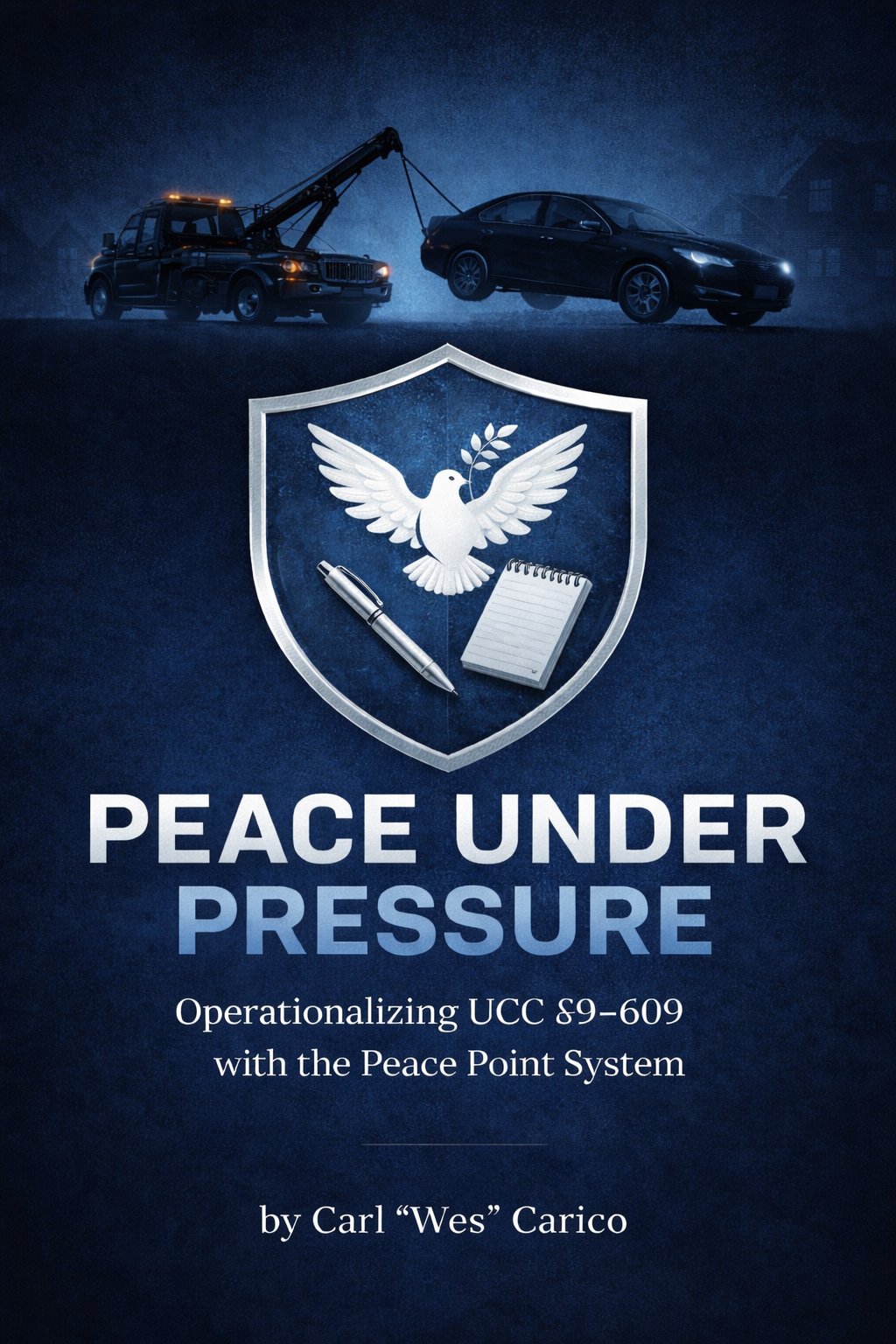
The full methodology is published in Peace Under Pressure — a citable, publicly available work that courts and counsel can obtain and reference independently of any testimony or engagement.

Carl 'Wes' Carico
The Author & Architect

Carl "Wes" Carico

Wes Carico developed the Peace Point™ System from the inside — as a recovery company founder and operator who understood, from direct field and management experience, exactly where the gap between UCC §9-609 and field practice created liability for everyone in the recovery chain.

He is the author of Peace Under Pressure: Operationalizing UCC §9-609 with the Peace Point™ System, the Peace Point Field Agent Guide, and the Professional Standards in Repossession series — the first published, comprehensive framework for professional standards in the repossession industry.

He also serves as an expert witness and consultant in repossession and collateral recovery matters, providing analysis grounded in the same published standards.
30+ Years Professional Service 82nd Airborne — U.S. Army Sergeant, Criminal Investigations CARS & CCRS Certified Recovery Master / Master Agent AFA Bonded  ·  ARA Member
Training, Licensing & Implementation

Agencies, Associations
& Lenders

The Peace Point™ System is available for agency implementation, association adoption, and lender compliance programs. Training materials and implementation frameworks have been developed. Inquire about licensing and partnership.

For attorneys & legal professionals: The published basis of the Peace Point™ System is available through Amazon. For expert witness, case analysis, or consultation inquiries, visit ccarico.com →
Submit an Inquiry